If you follow podcasts or any sort of social media, no doubt you’ve come across the concepts mindful meditation and mindfulness. They’re hard to miss. Maybe you’ve dismissed them as new age woo woo but there is much more to cultivating mindfulness than incense and relaxing music.
I’m not going to bury the leads here
- Mindfulness works to improve performance for many people (but not everyone)
- A mindful state takes time and effort to cultivate
- With that time and effort, you can learn to achieve a mindful state without sitting still and deep-breathing for 20 minutes
- Mindfulness can be beneficial in multiple realms of your life
In the words of the mindful movement’s founder, Jon Kabat-Zinn[1], “Mindfulness is awareness that arises through paying attention, on purpose, in the present moment, non-judgmentally.” Sounds straightforward, right? I’m sitting here at my laptop as I type these words, there’s music on in the café, there are people and conversations going on, my phone is sitting next to me, the fan is spinning above my head, and my tea has gone cold. That’s awareness, right? A mindful practice would have me go farther than that in paying attention.
If you read my introductory post, you may have picked up on how mental skills need to be trained just like physical skills. If you’ve tried meditation, yoga, breath work, or some form of mindful exercise 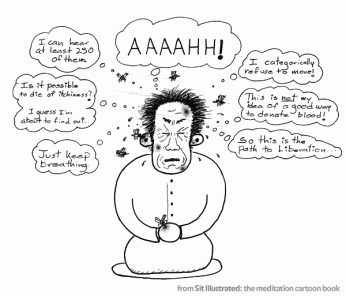 before and you didn’t think it was for you, I have a question. Did you try it once and think it was lame or too hard? Did you have an image of sitting in a full lotus position with birds perched on your shoulder and did you get frustrated when all you could think about was how much your nose itched and how the sweat was working its way toward your butt? You are NOT alone! Were you confused, bored, or distracted? That is TOTALLY NORMAL.
We train our minds just like we train our bodies. A young dancer gets frustrated because they can’t do a particular movement. Do we tell them to quit dancing? Probably not. We find ways to help them correct technique, encourage changing approach, find a method which works, and then we tell them to practice. Mindfulness requires the same tenacity while also encouraging gentleness with oneself and the world.
I can hear you now, “Whit, why would I meditate? It’s just not for me. I can’t meditate when I’m hurtling down a mountain at a hundred KPH. I don’t mediate while I’m singing, and I certainly don’t mediate when I’m responding to a four-alarm fire!” I hear you and I totally agree that mid-air is not the time for a full lotus.
I like to think of Meditation as training and Mindfulness as the execution in our mental skills practice[2]. We use meditation to build space inside ourselves and to cultivate a mindful state of being. By training and growing that space of calm and centered energy, we can learn how to draw upon that energy at will. Take that skier flying down the mountain for example. She may not be consciously meditating but when she starts to lose an edge, the calm space that she has created by training her mind may allow her to recover he center line rather than losing her balance. The singer who is about to hit the challenging passage in his recital may find that instead of straining for the breath, he is able to find the air without tension because he has trained his mind to let go of anticipating tension. And that firefighter might be able to respond with a flexible mind instead of rigid tension when things don’t go as anticipated because she can draw upon a mental image she built just for that purpose. All of these results can take less than a second to access and may make just enough of a difference to alter performance.
So, as I move along with this blog, I am going to encourage you to seek out a mindful meditation practice. It can be anything from a formal yoga practice to an informal walking and conscious breathing while you’re walking the dog or taking a shower. I will be writing more about mindfulness but reading words on a screen is no substitute for purposeful doing. There are resources out there for you to find the methods which work for you.
Let me know what you discover!
[1] https://www.librarything.com/author/kabatzinnjon
[2] This is, of course, incredibly over-simplified but bear with me for a while
 Let's Count to Potato
Pingback: What Can SPP Do for Referees and Umpires? | On the Horizon